

Child bladder diary
Information clinically reviewed by Bladder & Bowel UK – August 2026
A bladder diary for children — sometimes called a frequency volume chart — is a record of what your child drinks, how much wee they pass and when, whether they have been wet, and when they open their bowels. It is usually filled in by a parent or carer over two or three days, and taken to your child’s appointment.
This resource is produced by Bladder & Bowel UK, a charitable service supporting people with bladder and bowel conditions.

Why is completing an adult bladder diary helpful?
A bladder diary gives your child’s healthcare professional a clear picture of how your child’s bladder and bowel are working. It shows how well their bladder is storing wee, how much they pass each time they go to the toilet, how much they are drinking across the day, and when any wetting happens.
Patterns that are hard to spot day to day often become obvious once they are written down — for example, a child who drinks very little until the evening, or who passes only small amounts each time they go.
Fill the diary in for at least two full days. A single day rarely gives a true picture.
Before you start — planning your two days
Choose days when your child will be at home. You will need to help them measure how much wee they pass each time, and most schools and nurseries do not have the resources to do this.
A full weekend usually works best during term time. In the school holidays, any two days in a row are fine.
Measure their cup, glass or bottle once before you begin, then use the same one throughout. You can then estimate drinks quickly without measuring every time.
Keep a jug or measuring container by the toilet so it is there when your child needs it.
Pick days close to the appointment so the information is current.
If your child wears nappies during the day, use the baseline bladder and bowel chart instead — it is designed for children who are not yet toilet trained in the day.
How to fill in the diary
The diary has three columns for each day: drinks, urine and bowels. Fill in the row for the time each thing happens.
Drinks Each time your child has a drink, write down what it was and roughly how much — using the cup or bottle you measured at the start.
Urine (wee) Ask your child to wee into a jug or container each time they go to the toilet, then measure it and write the amount in the urine column.
Wetting If your child was wet, record how wet using these codes:
Code and what it means
WS = Small — underwear damp or wet
WM = Medium — underwear and outer clothing wet
WL = Large — clothes wet through, with a puddle
Bedtime and waking
Write B in the row for the time your child goes to bed, and M in the row for the time they wake up in the morning.
Bowels (poo) When your child opens their bowels, use the Bristol Stool Chart to find the number closest to what they have done, and write that number in the bowels column.
Example diary entry
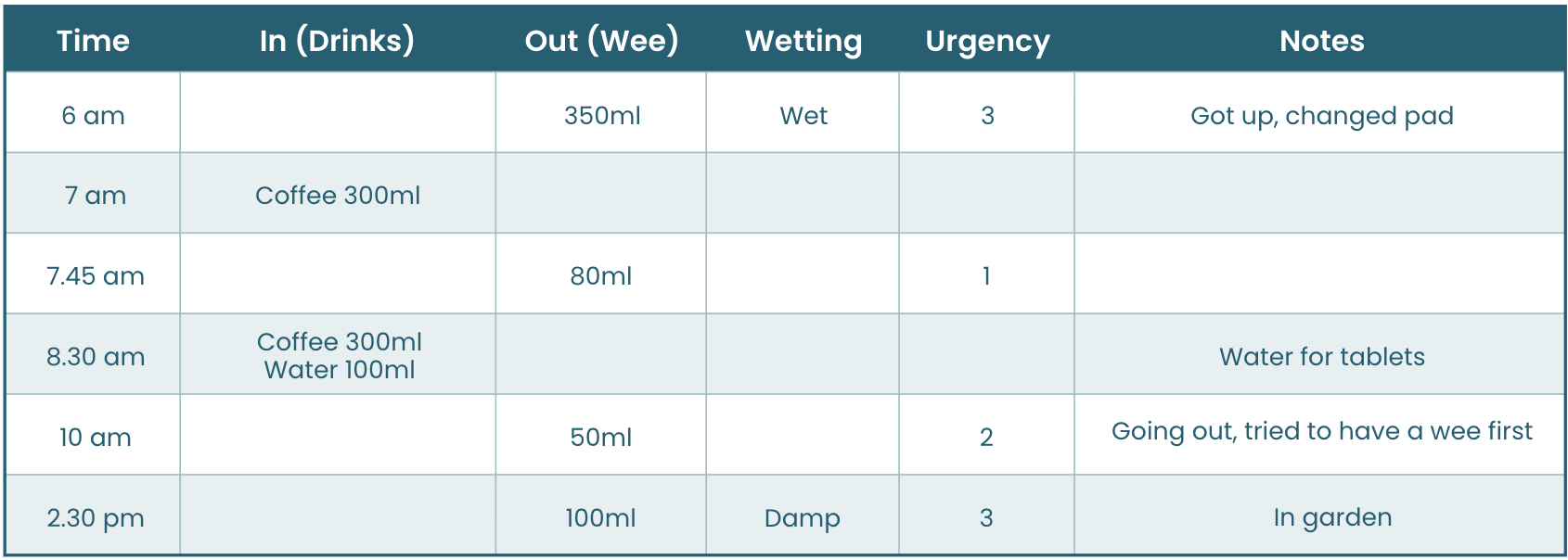
Download your free bladder diary for children
The Bladder & Bowel UK baseline bladder diary for children is free to download and print. Remember to take the completed diary with you to your child’s appointment.
Frequently asked questions
Or speak to a member of our clinical team
A bladder diary for children is a record of what a child drinks, how much wee they pass and when, any wetting, and their bowel movements. It is usually completed by a parent or carer over two or three days and taken to a healthcare appointment.
At least two full days. A single day does not usually give a true picture. A weekend often works best during term time, because your child needs to be at home so you can help them measure.
Keep a jug or measuring container by the toilet and ask your child to wee into it each time they go. Measure the amount and write it in the urine column of the diary.
They record how wet your child was. WS means a small amount — damp or wet underwear. WM means a medium amount — underwear and outer clothes wet. WL means a large amount — clothes wet through, with a puddle.
Usually not. Schools and nurseries do not generally have the resources to measure how much wee a child passes, which is why the diary is best completed on days your child is at home.
Use the baseline bladder and bowel chart instead. It is designed for children who are not yet toilet trained during the day.
Yes. The diary includes a bowels column. Use the Bristol Stool Chart to find the number closest to what your child has done and write that number in.
Further information and support
For more information visit our adult bladder page and information library online. You can also contact the Bladder & Bowel UK confidential helpline online or by phone 0161 214 4591.
For further advice on bladder and bowel problems, speak to your GP or other healthcare professional.
Author – Bladder & Bowel UK clinical team
Last reviewed: August 2026 · Review due: August 2029
